Friday, February 27, 2009

A Portrait of the Author as a Young Man

Tho' much is taken, much abides; and tho'
We are not now that strength which in old days
Moved earth and heaven, that which we are, we are;
One equal temper of heroic hearts,
Made weak by time and fate, but strong in will
To strive, to seek, to find, and not to yield.
--Alfred, Lord Tennyson, "Ulysses"

My wife has recently posted excerpts from my old journal on her blog, mostly as a way to mock me. I have decided to do the same. 

From 6/12/1997 to 8/28/1998 I kept the journal. I was a senior in High School at that time. A lot of what I wrote is really lame. Some of what I wrote is kind of funny, even though I didn't mean for it to be funny at the time. I took myself very seriously then, and the journal ended before I learned to laugh at myself. 

Here are two of my favorite excerpts. I like them because I think they capture best how I remember myself being at that time. 

from 7/1/97

"What would people think of me after reading the volumes of my life? I could say I didn't care, but that would be a lie. Anybody who doesn't care is lying--including myself! I do care a lot about most things. I want things to turn out right for people--somewhere inside of me I believe that. Maybe the part of me that I should show more. I don't show enough of myself. I plan to change that someday. Probably when my penmanship improves.

"Thus is life, I often say. I often say that to make me sound like a philosopher, when all I really am is one who points out something someone has already pointed out. That's the problem with this world. Everything has been said and done and we are just stuck waiting for something new to happen. 

"It is midnight, and if I had any sense, I would go to sleep.

"But I can't.

"Things go through the mind that keep you awake. Things that only clearly come to mind during the late hours of the day. Things too important or too unimportant to think about during the day. Things like the Eagle and college and all the crap like that. Other things--the unimportant things-- are the things that one enjoys thinking about at night. Things like having fun, etc. I think that's just as important, though." 

And, from 11/20/97

"I want to leave this place. The people here are driving me crazy. I could pick out only a hand full of people I like to spend my time with. I want to leave and find who I really am. Put all this crap I'm writing about in this entry into action. It seems life is struggling to keep a hold of me. If I don't break free from this life soon, I'll crack. Everything is going so slow. I want to get on with my life.

"I will never conform to any will but my own and God's. Now to put it into practice. I like God. He has help[ed] me through a lot. He is sometimes the only one I care to have anything to do with. I'd like to go out into the desert like Jesus did. I think I'd learn a bit. A bit more than I'm learning here, sitting around in the idleness of youth.

"There is a life out there for me. It will be my own life. Why do I feel, though, that my life isn't my own sometimes. We learn that we must be successful in life. I say that success is fleeting and one should focus on the stuff you can take with you." 


Wednesday, February 18, 2009

"Let Me Show You What Love Can Do": A Review of Springsteen's Working on a Dream

Despite its title, Bruce Springsteen’s Working on a Dream (released January 27, 2009) does not mark the Boss’s return to working class music. Rather, it stands as another reminder that Springsteen is far removed from that working class minstrel we hear in Darkness at the Edge of Town, The River, and Born in the U.S.A.

Not that that’s a bad thing.

Springsteen is now in his early sixties, which means he’s only a few years away from getting a senior citizen’s discount at the local picture show. In the twenty-five years since Born in the U.S.A., his last overtly working class album, he has been writing music that reflects the changes of perspective that have come with aging and maturity. His commercial successes and failures of the past twenty years—and especially his marriage and family life—have taken his mind and music away from their working class roots. Because of this, some so-called fans have accused him of losing touch with his audience or selling out to the Man. They forget, of course, that there’s nothing worse than watching an aging rocker imitate his younger self on a PBS special. No one wants to see the Boss pretend to be 35.

In many ways, nothing on Working on a Dream is new for long-time fans of Springsteen. It is stylistically similar to Springsteen’s most recent release, 2007’s Magic, but leans thematically towards 2002’s The Rising. In many ways, it is also something of a capstone album for the whole of Springsteen’s work produced during the Bush administration. For instance, the album’s fifth track, “What Love Can Do,” seeks practical reconciliation between the optimism of The Rising and the pessimism of Devils and Dust (released in 2005) and Magic:

Darlin’, I can't stop the rain
Or turn your black sky blue
But let me show you what love can do
Let me show you what love can do

The notion that love and relationships are the only anchors in troubled times is repeated several times throughout the album. In “Lucky Day,” for example, the singer takes comfort in the knowledge that “In the dark of this exile / I felt the grace of your smile.” Likewise, in “This Life,” the singer reflects on “This emptiness I've roamed / Searching for a home,” ultimately concluding that “With you I have been blessed, what more can you expect.”

Working on a Dream also explores the darker side of love. In “Queen of the Supermarket,” for example, a lonely shopper sings about his love for a beautiful cashier and the “cool promise of ecstasy” awaiting him at the grocery store where she works. The shopper’s love is unrequited, though, and his inhibitions keep the “cool promise” from being fulfilled. For him, love becomes something of an empty dream; while he finds happiness in the sight of her beauty, the happiness is only temporary. At the end of each day, he is still alone:

I'm in love with the queen of the supermarket
There's nothing I can say
Each night I take my groceries and I drift away, and I drift away

In “Life Itself,” which is possibly the best song on the album, Springsteen continues to explore the darker side of love. In this song, the singer is caught in a demanding relationship with a self-destructive lover:

I knew you were in trouble anyone could tell
You carried your little black book from which all your secrets fell
You squandered all your riches your beauty and your wealth
Like you had no further use for, for life itself

Springsteen, of course, is ambiguous about gender in “Life Itself,” suggesting that the lot of the singer is more universal than unique to men only or women. So, too, seem to be the questions asked of the listener:

Why do the things that we treasure most, slip away in time
Till to the music we grow deaf, to God's beauty blind
Why do the things that connect us slowly pull us apart?
Till we fall away in our own darkness, a stranger to our own hearts

These questions, in many ways, cut at the heart of the optimism in Working on a Dream, for they remind listeners that “the things that connect us”—i.e. love and relationships—often carry a high price, especially in demanding relationships like that in “Life Itself.” The singer’s frequent repetition of the phrase “I can’t make it without you,” however, illustrates the depth of his or her seemingly irrational reliance on a connection that will inevitably prove destructive. The singer’s voice, after all, is sincere; he or she seems willing to face inevitable destruction for the chance to “make it”—so much so, in fact, that the singer ends the song with a toast of commitment to the relationship:

So here's one for the road, here's one to your health and to
Life itself, rushing over me
Life itself, the wind in the black elms,
Life itself in your heart and in your eyes, I can't make it without you

“Life Itself” stands alone in its bleakness. Most of Working on a Dream remains upbeat, often in spite of its awareness of hard times. The title track, “Working on a Dream,” is catchy and fun to sing along to. “Good Eye” is another good track, although it is largely incoherent. “What Love Can Do” is one of the best songs on the album, as is the bonus track “The Wrestler.” The peppiest song on the album is a mediocre track entitled “Surprise, Surprise,” which easily wins the “Most Obnoxious Chorus” award:

Well, surprise, surprise, surprise
Yea, surprise, surprise, surprise
Well, surprise, surprise
C'mon open your eyes and let your love shine down

One low point on the album, however, is the song "This Life," which has good lyrics but a forgettable melody. The same can almost be said about the song "Kingdom of Days," which is a love song about growing old. "Kingdom of Days" is growing on me, though.

Ultimately, Working on a Dream is Springsteen meditation on the kind of resignation that seems to come with age and maturity. Likely, the album signals the beginning of the end of the Boss. In the years to come, his albums will become much less political and increasingly more aware of his limitations. As a fan, I understand that this is inevitable.

Sing away, sing away, sing away, sing away

Wednesday, February 4, 2009

Meyer's New Moan and Groan (and Groan): A Review

"What kind of place was this? Could a world really exist where ancient legends went wandering around the borders of tiny, insignificant towns, facing down mythical monsters? Did this mean every possible fairy tale was grounded somewhere in absolute truth? Was there anything sane or normal at all, or was everything just magic and ghost stories?"

In astronomy, a new moon occurs when the moon is situated directly between the earth and the sun, thus making the it darken and seem to disappear. Stephanie Meyer seizes upon this symbolism in New Moon, her follow-up to Twilight, by placing her melodramatic heroine, Bella Swan, between two young men who really, really, (c'mon) really love her: Edward, her stone-faced (and extremely boring) vampire boyfriend, and Jacob, her emotionally unstable best friend, who also happens to be the most powerful werewolf on the local Indian reservation.

Sounds ridiculous, doesn't it. If you are like me, you are probably wondering what is up next for poor Bella? A pen pal who happens to be Frankenstein's monster? A swimming date with the Creature from the Black Lagoon? Maybe a crush on Igor?

Fortunately, Meyer knows her books are ridiculous...or, at least, I think she knows. Several passages in New Moon, after all, seem more than a little tongue-in-cheek. Take, for instance, Bella's inner turmoil as she struggles to come to terms with Jacob's lupine state:

"I pulled up to the Black's house with my lips pressed together into a hard line. It was bad enough that my best friend was a werewolf. Did he have to be a monster, too?"

Bad enough, indeed, Bella.

New Moon is full of such passages, and rightly so. For a plot to be taken seriously--at least, the kind of plot like we see in New Moon--it needs to convey a certain amount of pathos, or serious, intense emotion. What Meyer gives us is bathos, or emotion that is so ridiculously over-the-top that it becomes funny. While most bathos in literature today is unintentional, I believe Meyer's is not--at least, I hope it isn't. I have hard time believing that Meyer is not giving me a knowing wink as I wade through the endless barrage of gasps and snarls and moans and groans that is New Moon.

Yeah, she seems to say to me, I know its ridiculous. Keep reading.

New Moon--which could also be titled I Was a Teenage Werewolf (or, more accurately, I Was in Love with a Teenage Werewolf after My Boring Vampire Boyfriend Dumped Me)--begins about a year after the events of Twilight. Life is perfect for Bella until she receives a near-fatal paper cut (I'm not making this up, folks!), which acts as a wake-up call for her vampire boyfriend, who realizes that the only way he can ensure Bella's safety is to dump her and "move" to L. A.

Such is life. At least in vampire fiction.

For the next THREE HUNDRED PAGES, Bella moans and groans (and moans and groans) about losing Edward, decides to live "dangerously", and becomes BFFs (and maybe a little more) with a kid named Jacob, who is two years younger and appeared briefly in Twilight. The plot thickens (not unlike blood) when Bella learns that Jacob is a werewolf, which means he is the sworn enemy of all vampires--including Bella's immortal beloved. As Bella is coping with this new development--and (as always) the absence of her vampire lover--she discovers that a vengeful evil vampire (i.e. one that drinks human blood) is out to get her. How will it end?

Well, the weakness of New Moon is that it never does. Before the showdown between the teenage werewolf and the vengeful vampire can occur, Edward's sister whisks Bella away to Italy in order to prevent Edward from committing vampire suicide. The rest of the novel focuses solely on the vampires, leaving the werewolves with little more to do than wag their tails. Jacob, of course, returns in the novel's epilogue, but the plot Meyer develops for the first 400 pages of the novel does not, which left me feeling a little shortchanged. Meyer spent page after page preparing me for a werewolf fight, but what I got in the end was a melodramatic vampire rescue mission.

This is unfortunate, of course, because Meyer's werewolves are much more interesting than her repressed vampires. In this novel, for example, Edward Cullen is about as dull and lifeless as the stone statues he is so often compared to. The same is also true about the other "vegetarian" vampires in his coven. Why? One reason, perhaps, is the control and restraint that they must exercise in every aspect of life.
In fiction, however, conflict is what generates interest, and "control" and "restraint," which are largely internal conflicts, do not translate well into external, visual conflict. Meyer's werewolves, on the other hand, have almost no control over their emotions and physical abilities, which makes them potentially more interesting. Jacob, in other words, generates more reader-interest than Edward--at least in this novel--because he seems always on the verge of losing his temper and killing Bella--or, at least, ripping her face off.

Ultimately, though, New Moon is not such a bad novel. In many ways, Meyer seems to have put more thought into developing its symbols and themes than she did in Twilight. What is more, she establishes a parallel between her plot and that of Shakespeare's Romeo and Juliet, which works fairly well for what it is. My main problems with it are essentially aesthetic. Meyer's use of language, for example, is awkward, while her handling of plot is (to use a Meyerian modifier) glaringly clumsy. Furthermore, her story is too big in scope for a single first-person narrator, which limits the action to what Bella--and only Bella--sees and feels. I can only imagine how much better this novel would be if Meyer gave us access to the minds of her repressed, internally-conflicted vampires.

But I'm taking this novel more seriously than Meyer wants me to. It is, after all, nothing more than a tongue-in-cheek melodrama about a teenage girl, her pet werewolf, and a jerk vampire who used to be her boyfriend.

Right?

Tuesday, January 27, 2009

Disposable Communication and the Lost Digital Generation

I recently finished reading Joseph J. Ellis's Founding Brothers: The Revolutionary Generation, the final chapter of which is about the John Adams/Thomas Jefferson correspondence, which lasted from 1812 until 1826, when both men died on the same day. In many ways, it is remarkable, considering how easy it is to destroy paper, that these letters are still around and available to the reading public. It is even more remarkable, however, that the Adams/Jefferson correspondence is not unique. Throughout the eighteenth, nineteenth, and early twentieth centuries, it was common for people to write letters and preserve them for posterity.

People still preserve communication. In fact, our society has become so communication-saturated that it seems almost impossible not to preserve communication, since the digital forums through which we transmit our communications often do the preservation and archiving for us. Still, while I have a digital record of all of my e-mail sent since 2005, I have no hard copy to speak of. Should I buy the proverbial farm, so to speak, kick the fatal bucket, or shuffle off the mortal coil, my family and friends will have no access to my digital correspondences unless they know the password for my e-mail account. My question, therefore, is this: what happens to such digital correspondences when the forums or technology that produce them become outmoded and obsolete? What will happen to your g-mail archive--or your blog, for that matter--when Google goes bust?

In many ways, we now approach written communication as something relatively disposable. To be sure, written communication has never been more popular. Text messaging, for example, has enabled people to carry on conversations in real time without ever opening their mouths. E-mail and online message boards have made correspondence faster and easier. Blogs have given everyone (including me) the opportunity to become a published writer--even if they have nothing to say. What is more, Facebook and other social networking sites have made it possible, via the "status update" feature, for people to create an hourly (yea, even a minute-to-minute) written record of their daily activities. No other era in history has written more than our own. Yet, what are the collected works of our era but words written on the swift current of an ever-widening river?

Two hundred years from now historians will likely face two problems. First, in their efforts to analyze and interpret our day and age, they will be overwhelmed with the surplus of digital junk--digital photos, documents, etc.--that they have to sift through in order to get at our heart and soul (provided, of course, that the technology needed to access our digital junk is still around). Second, once they are through sifting the digital junk, they will struggle to find our heart and soul because the forms of written communication that we have used to express ourselves most personally--text messages, e-mails, blogs, Facebook statuses, etc.--have been written on forms of disposable digital media. After all, what text-message conversation will outlast a cell phone replacement or an old cell phone plan? What e-mail will survive a discarded or forgotten e-mail address? What minute-by-minute Facebook status record will survive Facebook's inevitable demise? The fact of the matter is this: unless we actively archive our words on some enduring medium, they will be lost to time.

In Founding Brothers, Ellis makes the point that Adams and Jefferson were writing not only for themselves, but also for the generations of Americans who would follow them. That is, they wrote deliberately and with the knowledge that their correspondence would survive. Today, it seems, we often write without much thought for tomorrow. Will our posterity want to read our text messages? Will they want to know what our Facebook status was at 7:32 am on Tuesday, January 27, 2009? Maybe. Maybe not. I am willing to bet, however, that they will want to read something of substance from us--something that reveals, on a personal level, who we were as a generation.

Ernest Hemingway and his contemporaries were called the "Lost Generation" because they were perceived as being morally lost in the post World War I world. In many ways, today's generation is rapidly becoming a new lost generation--a "Lost Digital Generation," if you will--because what it has to say is written instantly, received and processed rapidly, and then immediately deleted.

Monday, January 19, 2009

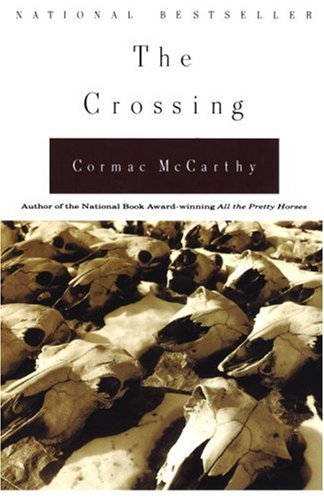
Cormac McCarthy's The Crossing: A Review

The Crossing is the second novel in Cormac McCarthy's so-called Border Trilogy. It tells the story of Billy Parham, a young man from New Mexico, who travels three separate times through Mexico in order to accomplish some personal mission. Along the way he encounters various drifters, cripples, gypsies, and aging revolutionaries who dispense wisdom and insight about the world.

While The Crossing is the second book in the Border Trilogy, it really stands on its own as a novel. It begins about a decade before the events of All the Pretty Horses, the first Border novel, and is similar to it in basic theme only. While All the Pretty Horses is much more reader-friendly (with lots of page-turning action and romance), The Crossing seems unconcerned about giving the reader an exciting plot. In fact, plot often takes second place to the big ideas that McCarthy is trying to work out through this narrative--and I use the word "trying" intentionally because I do not think he always succeeds.
That's not to say, of course, that this novel is a failure. The Crossing has a lot on its mind, and I would be lying to say that I came close to grasping half of it. It is the kind of novel that takes several readings to understand well (which, at 426 dense pages, is no easy task). Often, it seems, McCarthy's characters are attempting to negotiate the divides between realms of perceptions, such as the "real" and "unreal" or the "knowable" and "unknowable." The oft-recurring motif of the border crossing--the physical movement from one land to another--underscores this idea. All the Pretty Horses, from what I remember of it, is not half as cerebral as this novel.
Needless to say, if you are not interested in negotiating realms of perception, this novel might not be for you.

For all of its abstract ideas, though, The Crossing also tells an interesting story. Billy Parham's three "crossings" into Mexico cover much of the same terrain (physically and psychologically), yet each time he learns something new about himself and the world in which he lives. Over the course of the book, Billy's initial idealism is tried and tested and eventually worn down by failures, disappointments, and tragedies.
Again, if failure, disappointment, and tragedy are not your thing--skip this one.
Ultimately, I think that I liked The Crossing more than All the Pretty Horses. I also think that I liked it better than Blood Meridian, if only because it was not drenched in as much senseless blood and gore. The Crossing is a thoughtful novel about the tragedies and disappointments of youth, but it does not approach that subject with sentimentality. If grim novels about the loss of youthful idealism are your thing, give it a try--I mean, it only took me about six months to read.

Friday, January 16, 2009

HBO's John Adams: Balancing History and Drama

Had David McCullough never written his best-selling (and Pulitzer Prize winning) biography of John Adams, it is unlikely that HBO Films--or any motion picture studio, for that matter--would have thought of making a biopic about a founder father who enjoys neither the popularity of Thomas Jefferson nor the name recognition of George Washington and Benjamin Franklin. Indeed, thanks to McCullough, Adam's life and political career (and reputation) have been salvaged from the dust of history, packaged and delivered--in the best-selling form of popular narrative history--for the rabble masses that Adams often mistrusted. McCullough, therefore, also deserves further credit for HBO's recent mini-series on Adams, which is based on McCullough's book and also brings the founder's important and often over-looked legacy into the homes of those who were too lazy to read the book.

Admittedly, I am one of those who fall into the latter category. While I have owned the book since 2003, I was only able to read about 125 pages of it before I became distracted with another book (which tends to happen  a lot to me, since I try to read three or four books at a time). Still, my interest in finishing John Adams has never really diminished, and now, having watched all seven episodes of the HBO series, I have more of an interest in finishing it than ever.

HBO's John Adams, is a dramatic retelling of the United States of America's first 50 years. Adams, of course, is at the center of the action, along with Abigail Adams and the rest of the Adams family; Jefferson, Franklin, Washington, and Hamilton are very much secondary characters. Each episode of the series stands on its own; unlike other mini-series, no one episode leads smoothly into the next. Often, a lot of history is sacrificed on the altar of dramatic necessity--which is to be expected when 50 years of history is condensed into nine hours of film. Fortunately, the filmmakers did a fairly good job in making a project of this scope work. John Adams could have easily been fourteen episodes long, but that would have been a lot to ask from an audience. Overall, John Adams is a nice compromise.

The strength of this mini-series is its characterizations of the founders. Adams is a complex figure who has as many obvious flaws as he has extraordinary talents. The series makes much of his vanity and compulsive tactlessness, as well as his devotion to those whom he considered to be his best friends, namely Abigail and Jefferson. Also, it spends significant time on his struggle with parenthood (some of the best-acted scenes in the series, in fact, involve his role as a parent). Its characterizations of Jefferson, Franklin, and Washington are also excellent and do much to make them not appear like the marble statues they have become in our historical memory. Only Alexander Hamilton, who comes closest to being the "bad guy" of the series, comes across as being a little one-dimensional.

John Adams does have some shortcomings. Occasionally, the series depicts a historical event that, while action-packed, does little to advance the general story line. Adam's participation in an amputation during his first crossing of the Atlantic, for example, makes for an interesting scene--but little else. Personally, I wish the series gave more attention to politics than pageantry; the episode involving the Continental Congress, for example, seems incomplete, as does the episode involving Washington's presidency. That said, no episode entirely disappoints.

The tag-line for the series is "He United the States of America." At first, I thought this was a pretty clever piece of movie studio hyperbole. Now, however, having learned more about Adams and his contributions to America's founding, I think the line is appropriate. Adams, however vain and obnoxious he may have been, believed in doing what he felt was right, even if it wasn't always popular. When his contemporaries were separating into political parties, for example, or crying out for war against their European enemies, he resisted the trend and chose to follow a much more moderate path. The mini-series argues that doing so lost him the election of 1800 (and a more prominent place in popular history), yet ensured the stability of the new nation. If such was actually the case, Adams deserves all seven episodes that HBO has allotted to his life.

Saturday, January 10, 2009

A Study in Reading Habits: Low-Tech Advice

Five Rules I Read By:

1. Never read a history book by an author who is a journalist. Journalists aren't historians and usually do not write very good history. Journalists who are interested in history ought to take lessons from Tony Horwitz. He does not write history--he writes about it.

2. Be wary of novels by New England writers. I have nothing against New England and New Englanders, but I rarely like their novels. Since the days of Emerson and Thoreau, our friends from the Northeast have acted as if they own American literature. Usually, their novels are about self-absorbed thirty-somethings who have no grasp on life and wonder (over the course of 400 pages) why their lives persist in sucking. I recommend reading writers from anywhere south and west of New York.*

3. Avoid memoirs. Memoirs tend to consist of an overabundance of whine and cheese--if you catch my drift. I'm not usually interested in someone's alcohol problem or spiritual odyssey through Southeast Asia. I'd rather watch a Sponge Bob marathon than taint my soul with crap like Eat, Pray, Love or Reading Lolita in Tehran. If I want to read about someone's life, I'll read his or her biography (as long as he or she is dead).**

4. Remember that few novels sold at Wal-mart are worth reading. My heart grew sick the other day when I saw that Wal-mart is selling a mass-market paperback edition of Cormac McCarthy's The Road. Sure, good literature seems to be reaching the masses--but what price glory?

5. Avoid novels with a happy endings. Happy endings are for Hollywood. Nothing ruins a novel like a happy ending. As one of my BYU professors put it, a novel that ends happily is a novel that ends too soon. If I hear that a novel is uplifting or inspiring, I usually do not bother with it. I get my daily doses of happiness from real life. When I want to escape the happiness of the world around me, I stick my nose in a depressing book. Catharsis does wonders for the soul.***

* Yes, I know neither Emerson nor Thoreau were novelists. And I know that Cormac McCarthy was born in Rhode Island.
**I once read an excerpt of Eat, Pray, Love and nearly lost both of my eyes when they rolled too far back in my head. I actually don't know much about Reading Lolita--and what I do know about it doesn't interest me. I have read Barbara Ehrenreich's Nickel and Dimed, which is an example of memoir at its worst. I wouldn't line a hamster cage with that book. Educator Mike Rose has a lot of good things to say about education in America, but his memoir Lives of the Boundary spends far too much time on his often-irrelevant life experiences.
***Not all happy endings are bad. An ambiguous ending has saved many an overly happy ending.