I was digging through some of my old poetry and I found this strange piece of work. I'm not sure if I would call it good. I might call it okay. I would definitely call it weird. Some might call it a little gross.
I remember writing it late one night. Sarah and I were still living in Provo. Connor was probably just a baby. We lived on the bottom floor of an apartment building next to a laundromat, so we always had people walking past our living room window. Apparently, on the night I wrote this poem I let my imagination run wild.
I can tell that I wrote it at a time when I was still taking myself seriously as a poet. It has that sound to it. I also wrote it at a time when I was trying to write longer poems, which explains its wordiness.
Anyway, enjoy.
On Hearing Someone Sing Outside My Window
If I were alone and somewhere else—
in a cabin, maybe, in the secluded forests
of central Alaska—the soft singing
I just heard outside my window would be
disconcerting, if not scary.
I have seen enough movies to know
isolation provides the perfect setting for madmen
and murderers to play mind games on hapless
campers before finally finishing them off
with a sharp ax or kitchen knife.
If that were the case—if I were alone
in the woods with only the four walls of a cabin
to separate me from a suspicious song—
my imagination, which usually trampolines
to the grizzliest conclusions, would get the better
of me. In the initial fear of those first notes,
my body would shiver; salty drops
of sweat would run down the sides of my ribs
like earthworms, drenching the armpits
of my flannel shirt. My breathing, of course, would be
as labored as a freight train wheezing through the night,
my heartbeat like an alarm clock without a snooze
button. Even my toes, which are always so calm,
would panic and scramble for sanctuary.
After this rebellion of my senses is
quelled, I would barricade the door and windows
with my furniture, turning my rough-hewn
tables and chairs on their sides, pushing them
against anything that would allow access
to my rustic domain. Only then, with the cabin secure,
would I listen again for the eerie song of the stranger,
placing my ear, perhaps, to a drinking glass
against the wall. If I’m lucky, I would hear nothing,
the maniac singer having moved on to a cabin more worthy
of his art, one full of teenagers on spring break.
If I’m not so lucky—which is usually
how these things go for me—I would hear
the stranger’s song still outside my window
rise to a hideous crescendo, followed by a murderous,
calculating silence.
But I am not in a cabin in central Alaska.
I live in an apartment beside a Laundromat
where the procrastinators of the day go to wash
their clothes at night. The stranger, no doubt,
is some musically-inclined college student
who returned home from a good day with her books
only to discover, with some chagrin, that she had
no clean clothes for tomorrow—
hardly a maniacal ax murderer poised to hack away
my door, slice through the craftsmanship
of my barricade, and spill my blood on a grand scale
with plenty of splatter for the horrified investigators.
Friday, June 12, 2009


Thursday, April 30, 2009
Swine Flu Blues
A little humor for these perilous times...
Swine Flu Blues
My nose ran like a faucet,
So now I’m on the news.
My friends won’t dare to look my way.
I’ve got the Swine Flu Blues.
It started out as allergies,
Then turned into a cold,
And then I heard about this Flu
And placed my life on hold.
I bought a blue mask, just in case;
Flu meds I had to steal.
I looked around for kosher pork
To fix a pork-less meal.
I shunned my friends from Mexico,
Unlearned the Spanish tongue.
I plan to boycott Taco Bell
Before this song is sung.
So, as my heath care bills amass,
The doctors claim I’m fine.
But I know best: I’ll soon be gone.
These Swine Flue Blues are mine.
Swine Flu Blues
My nose ran like a faucet,
So now I’m on the news.
My friends won’t dare to look my way.
I’ve got the Swine Flu Blues.
It started out as allergies,
Then turned into a cold,
And then I heard about this Flu
And placed my life on hold.
I bought a blue mask, just in case;
Flu meds I had to steal.
I looked around for kosher pork
To fix a pork-less meal.
I shunned my friends from Mexico,
Unlearned the Spanish tongue.
I plan to boycott Taco Bell
Before this song is sung.
So, as my heath care bills amass,
The doctors claim I’m fine.
But I know best: I’ll soon be gone.
These Swine Flue Blues are mine.
Tuesday, April 21, 2009
A Great Closing Sentence
"We live in a world of transgressions and selfishness, and no pictures that represent us otherwise can be true, though, happily, for human nature, gleamings of that pure spirit in whose likeness man has been fashioned are to be seen, relieving its deformities, and mitigating if not excusing its crimes."
--James Fenimore Cooper, The Deerslayer
Sunday, April 5, 2009
Mormonism and a Magical America: a Review of Orson Scott Card's Red Prophet
 On 7 November 1811, on a hill near the Wabash and Tippecanoe rivers, Native American forces under the Shawnee prophet Tenskwatawa attacked American forces under William Henry Harrison. In the aftermath of the attack, which later became known as the Battle of Tippecanoe, 30 to 50 of Tenskwatawa's warriors lay dead on the field, and William Henry Harrison became an American hero.
Tippecanoe, however, plays out differently in Orson Scott Card's Red Prophet, a fantasy novel set in a "magical America that might have been." In Red Prophet, the battle is an outright massacre, and Card's telling of it owes as much to the Book of Mormon as it does to any American history book. Readers who are familiar with Alma 24, for example, will readily recognize Card's inspiration for the the group of pacifist Shawnee, led by the Prophet, who allow themselves to be massacred rather than take up arms against their attackers. Other Mormonism-inspired elements surface in the novel; most obviously, the life of Alvin Maker, the story's main character, seems at times inspired by the life of Joseph Smith, while the characters Tenska-Tawa and Taleswapper seem loosely based on the Angel Moroni.
In less creative hands, these Mormon elements might come off as either heavy-handed or corny--like an Osmond Brothers' concept album or a lame Halestorm comedy. Card, however, knows where and how much to borrow from Mormonism. So, while Mormon readers will understand certain aspects of Red Prophet differently than non-Mormon readers, non-Mormon readers will not likely feel like they're missing out on something crucial. Nor will they feel like they're being fed Mormon doctrine subliminally.
One downside of Red Prophet (for me, at least) is that it's the second volume of Card's "Tales of Alvin Maker" series, which means it's not a stand-alone novel. So, the first third of the novel is basically a retelling of Seventh Son, the first volume of the series, while the last third of the novel reads like a prelude for the third volume. What is more, the novel is dialogue heavy (in the bad sense), which is true of all of Orson Scott Card's novels. Still, Red Prophet has a great story to tell. Card's characters--both likable and detestable--are interesting, as are his descriptions of the Tippecanoe massacre and Alvin's spiritual experiences. Overall, I'd recommend the novel--and its predessesor, Seventh Son--to any fan of fantasy or historical fiction.
Monday, March 23, 2009
Six Word Reviews
I've been told that my reviews are too long, so I've decided to limit these to six words apiece.
Enjoy.
Books:
Andrew Jackson: His Life and Times by H. W. Brands
Good--but what's the real story?
Thirteen Moons by Charles Frazier
So lame. Mediocre TV miniseries material.
A Mercy by Toni Morrison
Better than Morrison's overrated novel, Beloved.
Graphic Novels:
Batman: Gotham by Gaslight by Brian Augustyn
Batman versus Jack the Ripper: Awesome.
Batman: Year One by Frank Miller
Should be titled: Gordon: Year One.
Movies:
X-Men: The Last Stand
Worse than X2? Are you serious?
A Boy Named Charlie Brown
Real winners are losers. Good grief.
Speed Racer
Ignore the critics. Reason: Racer X!
Books:
Andrew Jackson: His Life and Times by H. W. Brands
Good--but what's the real story?
Thirteen Moons by Charles Frazier
So lame. Mediocre TV miniseries material.
A Mercy by Toni Morrison
Better than Morrison's overrated novel, Beloved.
Graphic Novels:
Batman: Gotham by Gaslight by Brian Augustyn
Batman versus Jack the Ripper: Awesome.
Batman: Year One by Frank Miller
Should be titled: Gordon: Year One.
Movies:
X-Men: The Last Stand
Worse than X2? Are you serious?
A Boy Named Charlie Brown
Real winners are losers. Good grief.
Speed Racer
Ignore the critics. Reason: Racer X!
Monday, March 2, 2009
Massacre at Mountain Meadows (and Not Much Else): A Review
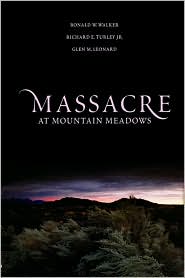 The Mountain Meadows Massacre is undoubtedly the darkest corner of Mormon history. When I first learned about it, I was sixteen years old and the grim details of the massacre--more than 100 men, women, and children slaughtered by a group of Mormons in southern Utah--were so shocking that I was convinced they were the product of some anti-Mormon propaganda mill. How could the Mormons, who had been so severely persecuted in Missouri and Illinois, be capable of such a crime?
Unfortunately, the massacre was no fabrication. On September 11, 1857, somewhere around 120-140 men, women, and children--California-bound emigrants from Arkansas--were massacred by a group of Mormon militiamen and their Paiute Indian allies. The attack occurred in the days leading up to the so-called "Utah War," when Mormons were receiving vague reports that the United States government had sent an army after them. Paranoia spread across Utah, and outsiders were looked upon with suspicion and scorn. At the same time, Mormons were in the midst of a spiritual "Reformation," which encouraged Mormons to rededicate themselves more firmly to living the precepts of their religion, including the defense of Zion.
While the massacre has never been as well known as other American massacres--such as the much, much smaller "Boston Massacre"--it has recently received some significant media attention. For example, the massacre became a matter of national news when critics of Christopher Cain's 2007 film September Dawn, which reduced the massacre (Titanic-style) to a melodramatic tale of star-crossed lovers, accused the director of making an "anti-Mormon" movie in order to disrupt the presidential campaign of Mitt Romney. Several best-selling books, too, have been published in the last decade--most notably Judith Freeman's Red Water (2002), Sally Denton's American Massacre (2003), Jon Krakauer's Under the Banner of Heaven(2003), and Will Bagley's Blood of the Prophets: Brigham Young and the Mountain Meadows Massacre (2004)--which examine the massacre in one form or another.
At best, the scholarly, fictional, and cinematic treatments of the Mountain Meadows Massacre seek to better understand the causes and consequences of the tragedy. Recently, some of this scholarship--Bagley's book in particular--points a steady finger of blame at Brigham Young, the Mormon leader who was no where near Mountain Meadows at the time of the massacre, but whose role as Prophet and President of the Church held no small influence over the Mormons. While no smoking gun has ever linked him directly to the massacre, Young remains a controversial figure in Mountain Meadows scholarship. So too remains Elder George A. Smith, a Mormon apostle who, in the weeks prior to the massacre, delivered a series of fiery sermons across southern Utah, which were largely designed to prepare the people for the rumored army invasion.
Ronald W. Walker, Richard E. Turley Jr., and Glen M. Leonard's Massacre at Mountain Meadows (2008, Oxford University Press) is the most recent contribution to Mountain Meadows scholarship. Authored by historians employed by the Church of Jesus Christ of Latter-day Saints, the book draws its account of the tragedy from both traditional sources of the massacre and "documents previously not available to scholars," such as assistant church historian Andrew Jenson's 1892 field notes from his interviews with "massacre insiders" (xi). Throughout the study, the intent of the authors seems to be to show how generally good people come to commit abominable crimes. Their focus remains tightly on the Mormon perpetrators of the massacre, exploring the motivation (or apparent lack thereof) behind their crimes. Attention, too, is given to the victims, the Fancher-Baker Company, although not as much as one would expect.
In many ways, Massacre at Mountain Meadows is a milestone in Official (or quasi-Official) Mormon history, which has a reputation (understandably) for being interested more in the inspirational side of the Mormon story than in the tragic and embarrassing. The book does not shy away from the violent crimes the Mormons committed, nor does it entirely shy away from exploring its controversies (such as Young's involvement, Smith's sermons, or John D. Lee's alleged rape and murder of two teenage members of the Fancher-Baker company immediately after the massacre). That said, at 231 pages (not counting appendices and end notes) the book is far too slim to be an adequate study. The authors acknowledge this fact in the introduction, stating that "too much information [on the massacre] existed for a single book," suggesting another book on the tragedy's aftermath will be written sometime in the future (xii). Still, the lack of any substantial information about the consequences of the massacre is the most disappointing aspect about this book. Upon finishing the book, I found myself researching "the rest of the story" on Wikipedia.
Another downside to the book is its lack of narrative energy. At times, Massacre at Mountain Meadows drags when the authors strive too hard to be moderate in their storytelling. Often, for example, the personalities of the Mormon perpetrators go unexplored and underdeveloped in the authors' attempts to be fair to everyone. Consequently, no real antagonist emerges in the narrative, except, perhaps, Isaac C. Haight, the Cedar City stake president who kept the momentum for the massacre up until it finally came about. John D. Lee, likewise, is a close candidate for primary antagonist, since it was he who led the initial attack against the Fancher-Baker company, yet the authors seem to dismiss Lee as a deluded, reckless zealot. Personally, I would have liked to see a more complete portrait of Lee's psyche. To a large extent, such portraits are what generate interest in historical narratives and compel readers forward. A more intimate account of the Fancher-Baker company's experience while under siege to their Mormon and Paiute attacks would have also helped the book along.
Despite its brevity, Massacre at Mountain Meadows is adamant on the point that Brigham Young did not condone the attack on the Fancher-Baker emigrants. While not an overt rebuttal to Bagley's 2004 book, this new study is clearly responding to someone. Unfortunately, nothing in the book is as conclusive on the subject as one would hope. Still, the smoking gun remains undiscovered--and Young's involvement with the affair is still only a matter of conjecture. Personally, I prefer to give him the benefit of the doubt.
Overall, though, I would recommend Massacre at Mountain Meadows to anyone who wants to learn more about the tragic event. It is certainly not a complete account of the massacre, but it seems like an adequate place to start.
But, then again, so is Wikipedia.
Friday, February 27, 2009
A Portrait of the Author as a Young Man
Tho' much is taken, much abides; and tho'
We are not now that strength which in old days
Moved earth and heaven, that which we are, we are;
One equal temper of heroic hearts,
Made weak by time and fate, but strong in will
To strive, to seek, to find, and not to yield.
--Alfred, Lord Tennyson, "Ulysses"
My wife has recently posted excerpts from my old journal on her blog, mostly as a way to mock me. I have decided to do the same.
From 6/12/1997 to 8/28/1998 I kept the journal. I was a senior in High School at that time. A lot of what I wrote is really lame. Some of what I wrote is kind of funny, even though I didn't mean for it to be funny at the time. I took myself very seriously then, and the journal ended before I learned to laugh at myself.
Here are two of my favorite excerpts. I like them because I think they capture best how I remember myself being at that time.
from 7/1/97
"What would people think of me after reading the volumes of my life? I could say I didn't care, but that would be a lie. Anybody who doesn't care is lying--including myself! I do care a lot about most things. I want things to turn out right for people--somewhere inside of me I believe that. Maybe the part of me that I should show more. I don't show enough of myself. I plan to change that someday. Probably when my penmanship improves.
"Thus is life, I often say. I often say that to make me sound like a philosopher, when all I really am is one who points out something someone has already pointed out. That's the problem with this world. Everything has been said and done and we are just stuck waiting for something new to happen.
"It is midnight, and if I had any sense, I would go to sleep.
"But I can't.
"Things go through the mind that keep you awake. Things that only clearly come to mind during the late hours of the day. Things too important or too unimportant to think about during the day. Things like the Eagle and college and all the crap like that. Other things--the unimportant things-- are the things that one enjoys thinking about at night. Things like having fun, etc. I think that's just as important, though."
And, from 11/20/97
"I want to leave this place. The people here are driving me crazy. I could pick out only a hand full of people I like to spend my time with. I want to leave and find who I really am. Put all this crap I'm writing about in this entry into action. It seems life is struggling to keep a hold of me. If I don't break free from this life soon, I'll crack. Everything is going so slow. I want to get on with my life.
"I will never conform to any will but my own and God's. Now to put it into practice. I like God. He has help[ed] me through a lot. He is sometimes the only one I care to have anything to do with. I'd like to go out into the desert like Jesus did. I think I'd learn a bit. A bit more than I'm learning here, sitting around in the idleness of youth.
"There is a life out there for me. It will be my own life. Why do I feel, though, that my life isn't my own sometimes. We learn that we must be successful in life. I say that success is fleeting and one should focus on the stuff you can take with you."
Subscribe to:
Posts (Atom)